The Arroyo Trabuco is a thin line of wilderness that cuts through the crust of suburbia, as if someone took his fingernail and scored it across a photograph. This deep ravine, often dry, a collected sandy mix of bluffs and sycamores and golden grasses, sends the water, if it rains, toward San Juan Creek, which in turn pours all that it collects into the wide, sad Pacific, the convex blue eyeball of the Earth.
You would never know it was there if you kept your focus on the road; the bridges, dated chronologically as sprawl expands, are anachronistic, modern-day structures that staple one new city to another. And if you look over to the side, you are likely to see a discarded couch, or worse, a bright green manicured golf course.
I know it doesn't matter much to people, that some land owners and stockholders capitulated and left this run-off ditch somewhat wild (actually it is buffered by cosmetically altered manmade marshes and collection tanks, water purification systems and garbage holds, and will never be "real" again). But almost all the land the arroyo served is absent--not gone, but altered with a veneer of plywood, plaster, stucco and asphalt, paint, parking lots, man. This kills all else, it makes the natural channels irrelevant. Why keep a skinny ragged seam of acreage, its tufts of yesteryear sticking out like some embarrassing tear in a brand-new pair of polyester slacks, why remember it, why preserve this strand of obsolete earth? You know why, even as it makes you sad: the land remains to remind you of your crime. You did this by existing.
Tuesday, January 17, 2006


Wednesday, November 16, 2005
After a year, thor_progeny web log hasn't caught on, and it has become more of a burden than a privilege or something I enjoy. I write every day, but fiction is easier for me. So thanks for reading, to those who did.
NPR reports that the number of grizzlies in the Yellowstone area has "tripled" since they were placed on the endangered species list (as threatened), but neglects to mention that there are still only 600 of them when it talks of their removal from that maligned roll call of human folly. Time Magazine may place Mother Nature as its "Man of the Year," but not because of its beauty or shredded interconnectedness. Because of bad weather that destroyed some manmade things.
It would be encouraging if people took an interest in their environment, reached out to the world that surrounds them (or once did), but it may be too late. People walk around looking down into their cell phones, punching numbers, seeing if that pic worked, watching tv shows, listening to music instead of birds (instead of traffic); they are focused on the foreground of man and technology, and the intricacies of the wild are left to schoolchildren and field trips, rare geologists and biologists who inevitably schill for corporate donors (or bosses), even against their intentions: "Save this poor acreage here, and you can develop all the rest." The world is not about rare butterflies and snakes; but these are the details that in concert create a vivid orchestra; we are down to solos and not even complete sonatas, now...down to measures, notes, and one day, silence.
Quiet photographs of Yellowstone National Park in October. What's left.

NPR reports that the number of grizzlies in the Yellowstone area has "tripled" since they were placed on the endangered species list (as threatened), but neglects to mention that there are still only 600 of them when it talks of their removal from that maligned roll call of human folly. Time Magazine may place Mother Nature as its "Man of the Year," but not because of its beauty or shredded interconnectedness. Because of bad weather that destroyed some manmade things.
It would be encouraging if people took an interest in their environment, reached out to the world that surrounds them (or once did), but it may be too late. People walk around looking down into their cell phones, punching numbers, seeing if that pic worked, watching tv shows, listening to music instead of birds (instead of traffic); they are focused on the foreground of man and technology, and the intricacies of the wild are left to schoolchildren and field trips, rare geologists and biologists who inevitably schill for corporate donors (or bosses), even against their intentions: "Save this poor acreage here, and you can develop all the rest." The world is not about rare butterflies and snakes; but these are the details that in concert create a vivid orchestra; we are down to solos and not even complete sonatas, now...down to measures, notes, and one day, silence.
Quiet photographs of Yellowstone National Park in October. What's left.
Friday, November 11, 2005
 Congress has once more scrapped "plans" to drill in the Arctic National Wildlife Refuge. It's the standard shampoo drill: Wait three months, propose ANWR exploration again, sneak it into some unrelated bill, raise hell to defeat it, repeat.
When the whole continent looked like this, before the attack of progress and colonialism and then of mass production, it seemed endless and immutable. Traveling this far took months or more, and by the time you got there, you had to go back or freeze your tuckus. And a lot of proponents of extracting the miniscule amount of petroleum under the ground use the area's remoteness as a cynical reason to chuck environmental studies. All these people making their phones ring off the hook will never live to see the place. What are they so upset about? In the 1800s, when a small group of crazy men tried to save sections of the West from exploitation, the "leaders" in Washington felt the same way. Who cares what happens way out there? It's not worth saving. They had to drag Presidents and dignitaries--in other words, people like you and me--all the way out into the wasteland to prove that it wasn't simply expendable, that it had true value and that protecting ecoysystems and monuments not only bestowed the inheritors of our country a stock of national treasures, but made the U.S. a truly benevolent country concerned about natural posterity.

It is true that the majority of Americans will never see the pristine Alaskan Arctic coast--that is, the small section that has been left undeveloped in the entire Arctic circle--and most will never hear its silence interrupted by the howl of wolves or the roar of grizzlies, a running herd of caribou. They won't feel the cool summer air, pure and clean as any on earth; they won't enjoy the flowers in August or feel the permafrost under their hiking shoes. I won't. But even if I were blind and deaf and unable to smell a skunk, I would know it was there. I would know that some small sliver of the Earth far from all this so-called civilization remained vibrant and open and that some day, maybe, it would inspire a revitalization of wilderness where I live. It existed once. It would be a shame to say the same thing of the entire world.
Wednesday, November 09, 2005
Update: They chose wisely.
Today in California, voters, meaning a scarce amount of people with time on their hands, will decide on issues in the "costliest election" in state history. Much of the ballot measures have to do with the speciously elected governor and his desire to gain control over how and where money is spent. Local measures include proposals to ban guns in San Francisco or, in Orange County, to shift a nickel from the police to the fire department -- things one would hope elected representatives could take care of on their own.
Another measure, however, could change the course of state geographical history by giving real estate developers a bold political precedent. This is how democracy works these days; a semi-educated populace, knowing it will lose the view it has grown accustomed to since it moved into its own new suburb, chooses whether to allow sprawl to continue up the hill. Developers pretend to care about the environment by cozying up to the cause--in appearance only--claiming that building a neighborhood run by solar power will "help" the state. Of course adding solar panels to existing communities would prove far more advantageous than breaking new ground on yet another abandoned "ranch," but that is not part of the argument.
These damned ranches in California, created by a so-called Mexican government that lasted less than 30 years, and by the Spanish land grants before that, divvied up by California settlers after 1850 and inherited for a century until the population began to exponentially devour every acre, have made urban planning a virtual impossibility. Only court fights and injunctions prevent the exploitation of every inch of available real estate, and the non-mountainous swaths John Muir didn't manage to save, owned by families-turned-corporations, get parceled off into the tiniest slivers so people can live out the American dream. Wise to this, voters in Livermore can choose whether to be conservationists for real...or in name only. To be sure, if they choose to prevent the development, they will be back next year putting a stop to it again.
Today in California, voters, meaning a scarce amount of people with time on their hands, will decide on issues in the "costliest election" in state history. Much of the ballot measures have to do with the speciously elected governor and his desire to gain control over how and where money is spent. Local measures include proposals to ban guns in San Francisco or, in Orange County, to shift a nickel from the police to the fire department -- things one would hope elected representatives could take care of on their own.
Another measure, however, could change the course of state geographical history by giving real estate developers a bold political precedent. This is how democracy works these days; a semi-educated populace, knowing it will lose the view it has grown accustomed to since it moved into its own new suburb, chooses whether to allow sprawl to continue up the hill. Developers pretend to care about the environment by cozying up to the cause--in appearance only--claiming that building a neighborhood run by solar power will "help" the state. Of course adding solar panels to existing communities would prove far more advantageous than breaking new ground on yet another abandoned "ranch," but that is not part of the argument.
These damned ranches in California, created by a so-called Mexican government that lasted less than 30 years, and by the Spanish land grants before that, divvied up by California settlers after 1850 and inherited for a century until the population began to exponentially devour every acre, have made urban planning a virtual impossibility. Only court fights and injunctions prevent the exploitation of every inch of available real estate, and the non-mountainous swaths John Muir didn't manage to save, owned by families-turned-corporations, get parceled off into the tiniest slivers so people can live out the American dream. Wise to this, voters in Livermore can choose whether to be conservationists for real...or in name only. To be sure, if they choose to prevent the development, they will be back next year putting a stop to it again.
Wednesday, November 02, 2005
 It took about 100 years of industrialization in America to figure out that the cavalier attitude of miners and millers and loggers, et al, grouped with the belching pipes of their factories, had coarsely scored away most of what made this continent appealing in the first place. It was a realization that came so late as to make it almost irrelevant, and to this day--despite an overage of evidence--the money lenders and moneymakers argue to the contrary with the cynical line that humans are clever people who will figure out a way around the dearth of open space, oxygen and clean water that remains.
 While the U.S. still struggles to define what is "resource" and what is in need of protection, our culture continues to consume far in excess of what we actually need or can even use. By moving almost all manufacturing and even some "extraction" offshore--much of it to our sort-of enemy/most-favored-trade partner, China--we have created a situation where we don't make our own mobile phones or even our own toothbrushes. And we have given a Communist dictatorship on the other side of the planet the opportunity to provide our government loans to pay off the interest on our exponentially accumulating debts.
Yet the up-and-coming Chinese say they remain thirsty. The 3,500-year-old nation's enormous human population is one part of the problem; but there is also the widely known but rarely mentioned scandalous shortsightedness of over-eager urban and economic growth without regard for the environment, a crisis egged on by American gluttony. Though in 2005 we rely on China to manufacture our socks and undies, our trinkets and toys, our batteries and armchairs--almost everything--we have yet to make arrangements for when that country's disorganized folly overdoses in, say, 2016, and collapses because of its defiant unrestraint. Despite large fears that America's "only" superpower status might give way to the Reds within a decade, where we go, they go... We can't buy Happy Meals forever. Nor can we ignore the ecological concerns of our providers, especially since we refuse to resolve our own.
Monday, October 31, 2005
creepy crawly things
On Friday's bicycle ride home, two gray, skinny coyotes stood beside each other, twins drawn out from the pack, and watched me from within a bushy outlet leading to, of course, a gated electrical transformer. Ah, wilderness.
These two could not have been alone, because unless he's solitary, a paired-off coyote has a family. So I did not pursue my curiosity. I've only seen lone coyotes in the past (at least up close) and so, in this case, I briefly entertained the idea of turning around and seeing what I could get myself into. But I know better than to approach wild animals. I could end up on the side of the road, ground up like a Manwich.
 Strange to see something living and something eyeing me as potential Halloween candy. Most animals I encounter in Southern California appear in corpse form...well, mammal-wise...I suppose birds and bugs trump the dead ones. I trip over morning roadkill on walks; on the way to work, I see dead opossums and raccoons, I ride by murders of crows picking apart the remnants of some fattened rodent, a squirrel or a rat--by that point you can never tell. The night before last, a crow went into a low circular dive and tried to clip my ear; I think my being the only person walking outside made for an easy target, but he missed. A small brown bird slammed into me once, but I was wearing a sky-blue shirt that day, and he appeared as confused as I was when I felt that erroneous punch in the shoulder.
Yeah, and spiders continue to invade my apartment way past summer; they're welcome to hang out if they stay off the bed and away from my cereal. Mostly they just perambulate around the ceiling of the bathroom and walk gingerly across the living room floor. The balcony is a mess of webs one day, but all that construction disappears on its own, and the gnawing grasshoppers that like to get into my plants always go away the day after an arachnid invasion.
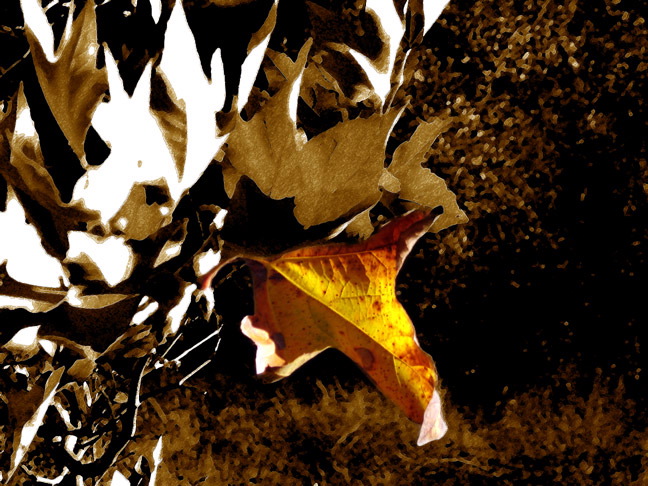
The largest black darkling beetle didn't bother to do a headstand when I neared it on Saturday, a short hike over the ridge, a trail so wet last year it has sprouted a crease of green grass where rainwater made a deep rivulet last spring. The leaves are changing very slowly this year, refusing to die. One sycamore had a single yellow leaf; all the rest remained green. So I killed them in that photograph.
These two could not have been alone, because unless he's solitary, a paired-off coyote has a family. So I did not pursue my curiosity. I've only seen lone coyotes in the past (at least up close) and so, in this case, I briefly entertained the idea of turning around and seeing what I could get myself into. But I know better than to approach wild animals. I could end up on the side of the road, ground up like a Manwich.

 Strange to see something living and something eyeing me as potential Halloween candy. Most animals I encounter in Southern California appear in corpse form...well, mammal-wise...I suppose birds and bugs trump the dead ones. I trip over morning roadkill on walks; on the way to work, I see dead opossums and raccoons, I ride by murders of crows picking apart the remnants of some fattened rodent, a squirrel or a rat--by that point you can never tell. The night before last, a crow went into a low circular dive and tried to clip my ear; I think my being the only person walking outside made for an easy target, but he missed. A small brown bird slammed into me once, but I was wearing a sky-blue shirt that day, and he appeared as confused as I was when I felt that erroneous punch in the shoulder.
Yeah, and spiders continue to invade my apartment way past summer; they're welcome to hang out if they stay off the bed and away from my cereal. Mostly they just perambulate around the ceiling of the bathroom and walk gingerly across the living room floor. The balcony is a mess of webs one day, but all that construction disappears on its own, and the gnawing grasshoppers that like to get into my plants always go away the day after an arachnid invasion.
The largest black darkling beetle didn't bother to do a headstand when I neared it on Saturday, a short hike over the ridge, a trail so wet last year it has sprouted a crease of green grass where rainwater made a deep rivulet last spring. The leaves are changing very slowly this year, refusing to die. One sycamore had a single yellow leaf; all the rest remained green. So I killed them in that photograph.
Wednesday, October 26, 2005
Dusk wells up nostalgia; nostalgia, that false sense of a glistening past: the cool air and clouds of soft gray wool, the occasional puddle and all the fallen leaves swept off driveways into the street; strings of plastic pumpkin lights instead of carved jack-o-lanterns; I'm unfamiliar yet reminded, and some bluish patches beyond the cloudy sky have tiny stars still there from before, and every day they move. I don't like the shadows cast by street lights; or maybe I do. I just don't like the lamps themselves. Cars go by, one after another, but I think people are only going through the motions of running errands; nothing they need is all that immediate. They could walk, too.
And I would like to walk at this time of night more often, but this time of night will never come again. Every moment presents the next ridge of an ever unfolding fan; the view back is equally obscured by such creases, making memory equivocal, the past subjective and only unyeilding in its ambiguity. I wonder if to walk at night on this sad hillside 50 years ago made any sense at all. Where would one walk to? How many sheep would bleat as one passed? Did the birds then, confused as they are now, cry out to each other checking the time? Verifying day from night was easier, maybe; this was a pasture, and I don't know the old geography. I suppose the fog had meaning. A drunken ranch hand would know its significance; he couldn't drive back from the town on the oceanside; he would have to sleep it off in his truck. At this hour, the taverns over by the beach channeled all the revelers and tired laborers up and down a solitary highway; the paths out here had yet to be paved.
Anyway, I wasn't around.
And I would like to walk at this time of night more often, but this time of night will never come again. Every moment presents the next ridge of an ever unfolding fan; the view back is equally obscured by such creases, making memory equivocal, the past subjective and only unyeilding in its ambiguity. I wonder if to walk at night on this sad hillside 50 years ago made any sense at all. Where would one walk to? How many sheep would bleat as one passed? Did the birds then, confused as they are now, cry out to each other checking the time? Verifying day from night was easier, maybe; this was a pasture, and I don't know the old geography. I suppose the fog had meaning. A drunken ranch hand would know its significance; he couldn't drive back from the town on the oceanside; he would have to sleep it off in his truck. At this hour, the taverns over by the beach channeled all the revelers and tired laborers up and down a solitary highway; the paths out here had yet to be paved.
Anyway, I wasn't around.
Monday, October 24, 2005
From the "what the __?" file, a report that throws a little bleach onto the dark infection that is Wal-Mart. What sounds at first like enlightened corporate positioning leaves the almondy aftertaste of cynical marketing; otherwise why would we need to know? One would hope that civic responsibility comes with the territory of owning 10 percent of the retail market and controlling 2 percent of the American GDP. But that's the whole thing: being civil has never been profitable. Squashing small-town life and using cheap foreign labor to subvert all competition is the way to "win." Only the threat of lawsuits and visible protest compels the behemoth to shift. Because people who shop at Wal-Mart aren't worried about where things come from--they're worried about how much things cost and how many more things they can buy--the Davids in this Bibilical myth are competitive small business owners, eco-conscious rabble rousers and unionized hippies. We're gonna sell organic cotton shirts at Sam's Club. That should shut them up.
But you still shouldn't shop there. Check out Patagonia. Or other companies not trying to rule the world.
But you still shouldn't shop there. Check out Patagonia. Or other companies not trying to rule the world.
Thursday, October 20, 2005
When the early autumn puddles dried here in southern California I remembered the calls for action to the U.S. Army Corps of Engineers after the levees broke seven weeks ago in the other LA. Katrina even got the attention of those citizens previously (seemingly) inoculated to the facts: that gobs of money, for some reason, had flowed middle-eastward, clear across the globe, instead of toward an American community many suits had predicted would need it most if a natural disaster were to strike on target. It struck, and the cash that had not been spent helped create one big soggy septic tank of mankind meets destiny in the Big Easy.
In the Big Messy, meanwhile, since that's where the money--if not the water--has flowed, flooding is taking place on purpose. And, coincidentally, the ACE is in charge. This could be the bayou of southern Louisiana and the mouth of the Mississippi, but we have a city there, and people don't want to live in reed houses in America, much. It's ironic that what leads our politicians to feel umbrage at Saddam's ecological foibles does not extend to our own proclivity to channel nature as we see fit. Although the development of the largest river in North America began centuries ago, even a massive overflow of its banks a dozen years back didn't get the attention of civic planners south of St. Louis. If it did, it didn't extend to the federal level enough to raise the bar in those lower level river states to move people out of harm's way. So here we go again, rebuilding after the floods, draining water that, after all, is supposed to be there, and putting people on "dry" ground that doesn't stay that way. Maybe the Iraqis should count themselves lucky we dislike their former leader so much that we're doing the right thing.

In the Big Messy, meanwhile, since that's where the money--if not the water--has flowed, flooding is taking place on purpose. And, coincidentally, the ACE is in charge. This could be the bayou of southern Louisiana and the mouth of the Mississippi, but we have a city there, and people don't want to live in reed houses in America, much. It's ironic that what leads our politicians to feel umbrage at Saddam's ecological foibles does not extend to our own proclivity to channel nature as we see fit. Although the development of the largest river in North America began centuries ago, even a massive overflow of its banks a dozen years back didn't get the attention of civic planners south of St. Louis. If it did, it didn't extend to the federal level enough to raise the bar in those lower level river states to move people out of harm's way. So here we go again, rebuilding after the floods, draining water that, after all, is supposed to be there, and putting people on "dry" ground that doesn't stay that way. Maybe the Iraqis should count themselves lucky we dislike their former leader so much that we're doing the right thing.
Sunday, October 16, 2005
Between the thunder overhead and the rain popping off the balcony, drowning potted plants and the minor earthquake almost masked by my perpetually stomping (downstairs) neighbors, it might be easy to forget that I left town for nearly three weeks and have only recently returned. It may be time for a mid-life crisis and a permanent departure from this uncivilized and insouciant place where every time lightning flickers, teenaged girls scream as if they're watching fireworks. Resting after a long weekend of city living is impossible. Smack! It would be domestic violence if I knew them, but since I don't, I can only be accused of hateful thoughts and unrequited loathing.
Human intrusions of an unnatural nature in conflict with the weather or the earth's machinations bring out the best of my bilious loner persona. When at Yellowstone awaiting Old Faithful to gradually wind up and erupt, the crowd could not sit still; some parents contained their children, most let them run loose between the cold mock-wooden plastic benches untethered, unfettered, undisciplined. Older folks, and national park visitors are mostly older folks and German tourists, spoke loudly of the days when they could still hear. And cell phones rang and car horns bleated like the elk on the other side of the caldera; competed with the crows that cawed in echoic condemnation of our being there at all.

The kids--bored, waiting for the production to begin, for the crowning event and the whole purpose of coming to this bizarre place--could not sit still. I could, and so reduced to solitary middle-aged crank, did my best to fuss with camera, distract myself with alternating thoughts of self-annihalation and mass homicide until, after a couple practice belches, the geyser lifted out of its sulphuric pit with a soft hiss and, because the sun had set and twilight had settled over us, evaporated into a steam cloud before it could rise as high as I think it can get, for roughly 20 seconds silenced the crowd by being unexpectedly benign and imperfect; not the awe-inspiring icon documented on postage stamps and PBS documentaries, but a quiet moment of the Earth sighing, and I along with it, as everyone packed up and left, drove away to go to their hotels to turn on the TV.
I remained behind a moment to pay my respects.
Human intrusions of an unnatural nature in conflict with the weather or the earth's machinations bring out the best of my bilious loner persona. When at Yellowstone awaiting Old Faithful to gradually wind up and erupt, the crowd could not sit still; some parents contained their children, most let them run loose between the cold mock-wooden plastic benches untethered, unfettered, undisciplined. Older folks, and national park visitors are mostly older folks and German tourists, spoke loudly of the days when they could still hear. And cell phones rang and car horns bleated like the elk on the other side of the caldera; competed with the crows that cawed in echoic condemnation of our being there at all.


The kids--bored, waiting for the production to begin, for the crowning event and the whole purpose of coming to this bizarre place--could not sit still. I could, and so reduced to solitary middle-aged crank, did my best to fuss with camera, distract myself with alternating thoughts of self-annihalation and mass homicide until, after a couple practice belches, the geyser lifted out of its sulphuric pit with a soft hiss and, because the sun had set and twilight had settled over us, evaporated into a steam cloud before it could rise as high as I think it can get, for roughly 20 seconds silenced the crowd by being unexpectedly benign and imperfect; not the awe-inspiring icon documented on postage stamps and PBS documentaries, but a quiet moment of the Earth sighing, and I along with it, as everyone packed up and left, drove away to go to their hotels to turn on the TV.
I remained behind a moment to pay my respects.
Thursday, October 13, 2005
 I missed the expanse before it collapsed, and in my 4,200-mile round trips, I find the historical wonder of old prophets corrupted: The flow of rivers through the plains altered beyond Whitman's recognition; the shapes of forests, even their makeup, long changed since Powell explored the great West; lands fenced in, squared off, gutted and culled. Every year the main street of small towns gets to look more like the one I passed through 800 miles back, billboards like shutters and bright corporate logos behind them. All that was once wild--even with man upon it--for unimaginable millennia, is gone. A square of national park is not wilderness. It is tourist haven. I'm glad for these spaces, but they are sad reminders of what is forever lost.
And John Muir would not call "wilderness" the U-shaped valleys filled with homes that took two minutes to erect; he advertised the furthest rim of the Great Basin, the Range of Light, saved it in an exponential leap of conservationist faith. But in doing so he made all else seem second-rate and therefore exploitable. I love the slick gray California ridgeline, the steep peeks that alternate between smooth glass and broken shards. The sun cannot imitate itself, and every day there is some new shadow, some new pathway for the light to follow. Last winter saw a lot more weather than usual; even in May the white wooly coat of so many storms had barely tattered on the Sierra's back. The summer was hot, very, and so autumn gives us golden aspens and glowing foothills, with their steep stony overseers bald of snow looking frankly dark and satisfied with power. These mountains are impossible not to respect and beatify. Their scale and sheer intimidation invite allusions to old myth, while relatively new legends of exploitation (Gold! and Timber!) have become intrinsic to our culture. Mountainsides remain in the form of protected federal land, long ago picked over for their minerals and subsurface resources. The ancient cathedral forests of the Shoshone and Washoe disappeared in a few short mining years; the giant woods of the Lake Tahoe basin exist as logs in underground, abandoned Nevada silver mines. Now sticks of lodgepole pines, a poor replacement, give people the illusion of nature when, in fact, what we have sesquicentennially is a substitute, weed trees that took advantage of the scoured landscape.
We have to call some place home. I feel like a guest still, after 15 years of living here in California. But I feel like a guest everywhere else as well. I think we are all guests of a kind; some of us have the decency to leave the room clean when we leave. Some of us steal towels and tear up the sheets. Earth as bedraggled hotel. Needs a few billionaire investors for a facelift. Will never be the place it was, but we could at least return its dignity.
Wednesday, October 05, 2005
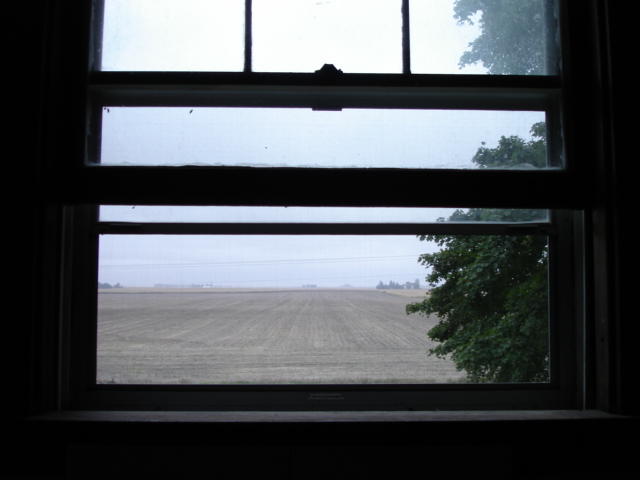 A cold front crawls toward the state, stirring up a thin soup of slow clouds on the horizon at 3 a.m., with ominous flashes that pop from south to north and back again like a line of '40s newspaper photographers. Above, the outstretched arm of our Milky Way adds its own speckled stripe to the already glittering black sky. But when will it start to rain? The temperature, thankfully, has dropped 15 degrees from yesterday and should drop another 15 by tomorrow. New snow on the distant mountains, too distant to know that by sight, may stay the winter--a welcome guest. Looking to the east, soybean fields already deconstructed by sturdy combines look like a striped brown rug on the floor of the earth. The sky at dawn is a wall with faded paint, crumbling white and gray, in need of a fresh coat. The wind continues, though; an endless white noise combs through the trees.
Yesterday, big--way-too-big--suburban houses built on this backdrop of farm country made me lean toward hating my fellow man; luckily they are impermanent, no matter how much destruction and stupidity they represent, the McMansions and their owners, too, will be whisked away some day, either by violent storm or by drifting, casual, indifferent weather.
Ah. Just now the first crack of thunder.
Monday, October 03, 2005
It's windy, and it's hot. The huge thudding hogs leave the slop near the barn and seek shelter beneath metal semi-circles held to the ground with spikes. Green combines harvesting soybeans stir up dust miles down the gravel road. It lands here, everywhere, sticks to window screens and plates. The farm dogs bark at the wind and the doors knock back and forth against their frames. Somehow the 100-year-old glass holds together. There are cats, too, but half of them are missing; the ducks, turkeys, geese and chickens seem to have allied in the coop, a treaty against a common enemy. Why is it 90 degrees in October? Where is the mud, and why all the dirt? The sheep kick up ground dry as stale crackers, bleating curiosity; like elderly cranks, they wander around the pen speaking their strange language of dependency and argument. And the trees have broken into brittle pieces, future firewood, stacked into heavy piles; and even fallen, their leaves remain green. Though it's autumn, the orange and red maple groves and deep merlot sumac bushes one expects beyond the golden corn, around homes and on the hills, hasn't appeared. It's the middle of July without the lemonade.
Yes, sir. Strange weather we're havin'.
Yes, sir. Strange weather we're havin'.
Saturday, September 24, 2005
 How can I write with any seriousness about nature for two or three readers when centingenarians are blowing themselves up on idling buses in record-breaking traffic jams to escape the inevitable sea-borne storms of September? Rather than dying unattached to oxygen tanks that keep them alive well past their due date, rather than dying with the wind and the rain that come along as part of a cycle of the seasons, these children who became seniors so suddenly can only cling to their lives. I guess they can't help it. Humans are attached to themselves and to each other, to living forever, no matter how. This instinct may be due to an assembly of atoms, perhaps an ancillary to one of Newton's laws my mom recalled on the phone: "Objects in motion tend to stay in motion." If we are so used to living, how can we accept a cessation of that motion? It is natural to die, but everything living struggles to survive at all costs. In fact only man seems to have the capacity to move beyond this obsession, but acceptance takes its time. Sometimes we never get to that point. If anything, Hurricane Rita can teach us to take a deep breath and know that if we choose to live, we ultimately choose to die. Deciding how --if not when-- is the question.
Tuesday, September 20, 2005
 A handful of neighbors, and there are so many of them, must have been either watching a sporting event in Asia or playing a visceral video game that made them holler like drunks last night, past 12. No different than usual, except that behind their backs, outside, an old, ragged phantom dragged its chains through the sky, causing sparks; every moment or so a new flash, sometimes a classic crooked finger, sometimes the flickering strobe of Pegasus flapping his wings followed by the crash of cymbals, a military drum salute. Even the loud bass boom overhead, a five-car-alarm deal that made horns sing like coyotes, didn't seem to distract these Monday night revelers. The power never went out.
The rain was intermittent, so I could leave the windows open. In fact the water that fell seemed an afterthought, as if shaken from an emptied bottle, the last remaining drops. And it was still hot, as it will be today when this dead Mexican hurricane disippates like fragile cheesecloth and scatters north and west. It was the most apoplectic storm I'd seen in years, seemingly more resentful in its tantrum because it could not find an audience. The vigorous crashing overhead surpassed the quota for thunder in Southern California. Most storms, like those of last spring, dump like waterfalls with a boom here and there; this was a sick monster dry heaving to no avail. How anyone could ignore its attempts to claim our attention, I don't know; I could not read or watch TV or turn away from the redolent ozone in the air, recalling wilderness and danger centuries old. In this new millennium, Nature can be turned away; it is, as I've mentioned before, a mere nuisance now, an afterthought unless it really breaks things up and becomes a spectacle worthy of being televised. And still people will leap to their mobile phones so they can laugh about it with their friends. Keep the booze flowing and the lights on, don't evacuate us from floods, don't shake the ground we walk on too violently, and we can go on with our lives pretty easily. Nature disrupts, but not much.
Thursday, September 15, 2005
 It isn't cheap to live on the Balboa Peninsula in Newport Beach (not that it is cheap anywhere in California), and residents there have little interest in making their community accessible to just anyone. It's a drag to park or even wind one's way through the stop lights and surf shops in order to get to the trucked-in sand.
I'm south of Newport by fifteen miles (an hour in drive-around-and-try-to-find-a-place-to-park time), and have only attempted to penetrate it twice. The land strangled by homes and "Fashion Island," the water gooped up with leisure boats and floating seafood restaurants; from the point of view of a window shopper, it's an exploded Nantucket trinket shop where rich people go shopping across the street. Even sea lions, indigenous but not endemic, are no longer welcome in these parts.
A lot of California cities revisit--a kind word--the architecture and lifestyle of other places. There is no more disingenuous a section of the nation in some respects. With its gold-country history long footnoted, the state remains a place to make money by recreating fiction and distraction. A housing development in Orange County resembles an Eastern Seaboard town, another is faux Italian; countless others are displaced from any main street in 1905. It's a realtime Disneyland, without Donald Duck or any store within walking distance. All boards and no resilience; closed doors, tiny lawns, groomed under committee bylaws.
Further north, Hollywood and Beverly Hills are still dotted with Old English office buildings and homes built by Charlie Chaplin (the inhabitants of which change over the years). Driving down the street in any neighborhood in LA, one home is Spanish-style bungalow, the next modern, the next French Colonial. In San Simeon, Hearst's paean to all things froufrou remains the quintessential Riviera ripoff. And Scotty's Castle in the middle of the desert defies even that excess. Then there are the miles of suburban development scattered all over the state, where cookie-cutter homes seem more like arms factories guarded by high gates.

No matter the scale of their endeavor, men with money build because they can, where they can. In the meantime, cultural landmarks, cities and neighborhoods overtake a place of natural beauty and wealth, not of the mineral, timber or acreage kind, but of wilderness and geography, of intangibles. Neighbor to countless bars, jazz clubs and millions of beachgoers, the Newport resident who claims the sea lions' bark "is far beyond normal-sounding sea life" has missed her calling as a true dramatic ironist.
Monday, September 12, 2005
LA in Lightness
I dunno about electricity blackouts or stuff like that or why they happen. But I do remember the darkness when the great natural disaster of 1994 struck Los Angeles (um, you may remember it as the most expensive of its time... I think it made headlines internationally, too, because it was so important) and how nobody could use candles for fear of gas explosions, and at 4:31 a.m. it suddenly became dark. I might have been able to sleep if it hadn't been for all the wreckage nearby and the poor people shouting at each other to grap their shit and get out! Well, I'm sorry, but that's the word they used.
Now here it is 11 and a half years later and someone cut a cable or something. I can't get far into the articles about it, as I am not a superintellectual able to grasp the great ramifications of temporary power outages in the middle of the afternoon. But it appears that these days every glitch in the superfluous grid that has weaved its way over the surface of our earth is a catastrophe. We're so dependent on the inventions of 125 years ago that we can't imagine living without elevators or microwaves or these infernal blogs, which...I know, are not so old... I could live without those three things, I think, maybe. But then technology has its high points; modern medicine keeps us alive when we're too young to die (cough), though it's no fun being a consumptive in the 21st century... you can't milk it for sympathy at all, they just stick you with a needle and you're back to dancing the two-step or whatever it is you do, back to cyber chatting or watching DVDs in your car or lollygagging around the house with your iPod or mobile phone or Xbox (I haven't quite figured out what an Xbox is yet, but it sounds dirty).
An unintended problem with technology is the reverse of one of its purported salvations. In its attempts to make all men equal, especially as it becomes either affordable or universally institutionalized, technology strips us of freedom and liberty. All people regardless of wealth must stop at red lights. We can't just start and go as we feel. And we're not free from the noise and lights created by modern man's mechanization. No matter where we live--outside of, apparently, North Korea--someone else's noise is our noise, we share the incandescence of others and remain at their whim off-switch-wise. Worse, weak and frustrated men can now find a way to make bombs. There are disparities that remain, but these differences decrease as prices lower. More and more people have computers and TVs, but less have knowledge of how they work. Devices superfluous to natural survival carry great weight, but people need them to be user friendly.
Meanwhile, "looters," which I have to put in quotes because according to some it's the wrong word, felt the necessity in some cases over in NOLA to steal televisions, without concern that they would have to deep sea dive in order to plug them in. I personally would have looted, that is, "rescued," books and other precious artifacts worth holding onto historically, but then that's just me. I don't eat much.

Now here it is 11 and a half years later and someone cut a cable or something. I can't get far into the articles about it, as I am not a superintellectual able to grasp the great ramifications of temporary power outages in the middle of the afternoon. But it appears that these days every glitch in the superfluous grid that has weaved its way over the surface of our earth is a catastrophe. We're so dependent on the inventions of 125 years ago that we can't imagine living without elevators or microwaves or these infernal blogs, which...I know, are not so old... I could live without those three things, I think, maybe. But then technology has its high points; modern medicine keeps us alive when we're too young to die (cough), though it's no fun being a consumptive in the 21st century... you can't milk it for sympathy at all, they just stick you with a needle and you're back to dancing the two-step or whatever it is you do, back to cyber chatting or watching DVDs in your car or lollygagging around the house with your iPod or mobile phone or Xbox (I haven't quite figured out what an Xbox is yet, but it sounds dirty).
An unintended problem with technology is the reverse of one of its purported salvations. In its attempts to make all men equal, especially as it becomes either affordable or universally institutionalized, technology strips us of freedom and liberty. All people regardless of wealth must stop at red lights. We can't just start and go as we feel. And we're not free from the noise and lights created by modern man's mechanization. No matter where we live--outside of, apparently, North Korea--someone else's noise is our noise, we share the incandescence of others and remain at their whim off-switch-wise. Worse, weak and frustrated men can now find a way to make bombs. There are disparities that remain, but these differences decrease as prices lower. More and more people have computers and TVs, but less have knowledge of how they work. Devices superfluous to natural survival carry great weight, but people need them to be user friendly.
Meanwhile, "looters," which I have to put in quotes because according to some it's the wrong word, felt the necessity in some cases over in NOLA to steal televisions, without concern that they would have to deep sea dive in order to plug them in. I personally would have looted, that is, "rescued," books and other precious artifacts worth holding onto historically, but then that's just me. I don't eat much.
Wednesday, September 07, 2005
 As an entry in the vast Earth(TM) Encyclopedia, the geologically adolescent land east of the California coast has a chapter all its own, with multiple sidebars: the hills as fertile pasture, where cows and sheep can roam and graze year round; flowers in the spring, golden grass in the summertime, green sod in January. Home to indigenous wildlife that threatens livestock, a place of American wineries, of sleeping volcanoes and winding old roads, the story told of oak groves and endless golden acres has enticed many a reader to its pages.
But the essence of place, its "value", radically changes from creature to creature. A different reader, looking up the same hills, sees them not as naturally productive and helpful to her bottom line, but as an unfinished canvas, as the ground for her work. She alters the land and builds, layer upon layer, as investor and developer who suffers a parodoxical obsession with transforming paradise. Each stunning ridgeline presents engineering, legal, social and marketing puzzles worth billions if solved in a certain way. The real becomes illusion.

A third person, anachronistic as the Chumash, might find in the pages of this listing an aesthetic and sometimes spiritual escapism. He may view the open space as sanctuary, as friend, as a land still alive. He may wonder why others skip this section of Earth(TM)'s book altogether, why they speed-read the pastoral vista toward a cityscape of integrated developments, rooftops, driveways, intersections and traffic. The difference may not even register to these disinterested people, as they head home, focused more on destination than journey: a nice big house in the suburbs, nestled somewhere in these hills, or somewhere beyond them.
Having read and reread it, I may need to put down the book myself, just to spare myself the horror of knowing.
Saturday, September 03, 2005
Meanwhile on the other side of the country, the grass which gives this state its nickname has dried crisp and turned golden. It shimmers brittle in the wind and heat with the rusty bramble and brown shrubs that were so green last spring--of course, only where threads of the ecosystem remain. The rest is a garden, constantly watered; the sudden phish-swish of sprinklers cranking up at night must cause heart palpitations in the brush rabbits that hop around on coastal golf courses.
Hungry masked raccoons had invaded the Dumpsters the other night when I got home from work, and they hesitated just a moment, made sure that I was not a cop and returned to their loot. Their paw prints, fossilized, remain along the dusty trail up here along the ridge, where only six months ago everything seemed under water and oozed with life; not that California dies once a year. It just becomes combustible. The flames both cull the old and create the new, but we call it a natural disaster when uncontained wildfires breech civilization and consume homes along the edge of where the world, beaten and battered, has some semblance of its old identity. Over in the heart of Napoleon's territorial giveaway, similar ethics apply; the natural world, so hidden beneath the unnatural, gains no friends by making an appearance. If we have fires out here this year (and we should, given the amount of rain last winter and how much non-human life the waters brought to fruition), our complaint will also be that due to the vagaries of nature, humans suffer all too much.

Hungry masked raccoons had invaded the Dumpsters the other night when I got home from work, and they hesitated just a moment, made sure that I was not a cop and returned to their loot. Their paw prints, fossilized, remain along the dusty trail up here along the ridge, where only six months ago everything seemed under water and oozed with life; not that California dies once a year. It just becomes combustible. The flames both cull the old and create the new, but we call it a natural disaster when uncontained wildfires breech civilization and consume homes along the edge of where the world, beaten and battered, has some semblance of its old identity. Over in the heart of Napoleon's territorial giveaway, similar ethics apply; the natural world, so hidden beneath the unnatural, gains no friends by making an appearance. If we have fires out here this year (and we should, given the amount of rain last winter and how much non-human life the waters brought to fruition), our complaint will also be that due to the vagaries of nature, humans suffer all too much.
Wednesday, August 31, 2005
The mayor says "likely, thousands" referring to the death toll from Katrina in New Orleans. This is no "American Tsunami," and it's distressing to hear that phrase because the rest of the country (heck, the world) knew about the hurricane a day or so before it hit, and heard repeated warnings that it was necessary to leave. I think assumptions about stubborness on the victims' part are moot. Poverty, mental and physical illness probably contributed more to these people being trapped than their own recalcitrance. What do you do in the event that you don't have a car and when you're all alone in a city that has neglected you for decades? You can only climb onto the rooftop for so long before the water goes over it. The hurricane lasted a few hours and picked off a few dozen here and there, but it is the broken levees, designed by men in suits to hold back the inevitable, that have done in these victims. Civil engineering arrogance did nothing to stop the Mississippi floods 15 years ago, or to hold together the Bay Bridge in 1989 or the I-5/14 L.A. interchange in '94 or the incessant coastal mudslides of Southern California. We expect nature to submit to our whims when we build cities in places they have no business being (even Las Vegas, like preserved glass in the dry heat, can only last until the next Ice Age). Mostly, New Orleans has filled like the sink it is; its foolhardy pipes have backed up with sharks and sewage in the mix and its basin has overflown. Intransigent nature eventually trumps human stubborness, even if it takes 300 years.
Subscribe to:
Posts (Atom)